A guide to insulating buildings: the benefits, the main materials and how to choose among them, how roofs, walls and glass are insulated, and the devices that measure the result.
Thermal insulation is a very important part of any building, for several reasons, including:
- Saving on heating and cooling: building insulation (wall insulation and roof insulation) is one of the main factors in saving on heating in winter and cooling in summer. It reduces the temperature difference between inside and outside, which means saving the money spent on energy and electricity.
- Limiting carbon emissions: thermal insulation is an effective way to limit carbon emissions, because it reduces the use of heating and cooling equipment that consumes electricity and causes those emissions.
- Limiting noise: thermal insulation reduces sound passing from outside to inside and the other way, and so helps to improve the quality of life inside buildings.
- Maintaining indoor air quality: thermal insulation reduces the temperature difference between inside and outside, which maintains indoor air quality and reduces the entry of cold or hot air into the building.
- Improving occupants' comfort: thermal insulation improves comfort inside the building by reducing sudden changes in temperature and humidity, and so creates a comfortable and healthy indoor environment to live in.
In general, insulation can be said to play a decisive role in improving the quality of life inside buildings and in achieving energy efficiency.
- Saving costs: thermal insulation is a good long-term investment. It helps to save the costs of heating and cooling and to lower energy bills.
- Limiting environmental pollution: thermal insulation limits the use of energy sources that produce polluting gases, which improves air quality and protects the environment.
- Improving property value: insulation can increase the value of a property, because it is an added feature that makes the building more attractive to buyers and tenants.
- Reducing the effect of climate change: suitable thermal insulation can reduce the effect of climate change on a building by achieving thermal balance inside it and improving its response to sudden changes in climate.
- Improving safety: thermal insulation reduces the likelihood of condensation, damp and ice forming on windows and surfaces, which prevents damage to electrical equipment and improves the safety of the building.
In general, thermal insulation is one of the basic factors that improve the quality of a building, provide comfort and energy efficiency, and reduce emissions harmful to the environment. For that reason, investing in insulation is an important and necessary investment for protecting the environment and improving the quality of life.
- Reducing noise: thermal insulation helps to reduce outside and inside noise, which improves occupants' quality of life and comfort.
- Keeping heat inside: insulation stops heat escaping from inside the building in winter, which keeps a comfortable temperature inside and helps to achieve thermal balance.
Further benefits of thermal insulation
Thermal insulation is a very important part of any building, for several reasons, including:
- Saving on heating and cooling: building insulation (wall insulation and roof insulation) is one of the main factors in saving on heating in winter and cooling in summer. It reduces the temperature difference between inside and outside, which means saving the money spent on energy and electricity.
- Limiting carbon emissions: insulation is an effective way to limit carbon emissions, because it reduces the use of heating and cooling equipment that consumes electricity and causes those emissions.
- Limiting noise: thermal insulation reduces sound passing from outside to inside and the other way, and so helps to improve the quality of life inside buildings.
- Maintaining indoor air quality: thermal insulation reduces the temperature difference between inside and outside, which maintains indoor air quality and reduces the entry of cold or hot air into the building.
- Improving occupants' comfort: insulation improves comfort inside the building by reducing sudden changes in temperature and humidity, and so creates a comfortable and healthy indoor environment to live in.
In general, thermal insulation can be said to play a decisive role in improving the quality of life inside buildings and in achieving energy efficiency.
- Saving costs: thermal insulation is a good long-term investment. It helps to save the costs of heating and cooling and to lower energy bills.
- Limiting environmental pollution: thermal insulation limits the use of energy sources that produce polluting gases, which improves air quality and protects the environment.
- Improving property value: insulation can increase the value of a property, because it is an added feature that makes the building more attractive to buyers and tenants.
- Reducing the effect of climate change: suitable thermal insulation can reduce the effect of climate change on a building by achieving thermal balance inside it and improving its response to sudden changes in climate.
- Improving safety: thermal insulation reduces the likelihood of condensation, damp and ice forming on windows and surfaces, which prevents damage to electrical equipment and improves the safety of the building.
In general, thermal insulation is one of the basic factors that improve the quality of a building, provide comfort and energy efficiency, and reduce emissions harmful to the environment. For that reason, investing in thermal insulation is an important and necessary investment for protecting the environment and improving the quality of life.
- Reducing noise: thermal insulation helps to reduce outside and inside noise, which improves occupants' quality of life and comfort.
- Keeping heat inside: thermal insulation stops heat escaping from inside the building in winter, which keeps a comfortable temperature inside and helps to achieve thermal balance.
- Keeping the building cool in summer: thermal insulation keeps the building cool in summer by stopping outside heat from entering and preserving the flow of cool air inside.
- Maintaining humidity: thermal insulation improves the air quality inside the building and keeps humidity at suitable levels, which protects the building and extends its life.
More advantages of thermal insulation
- Improving occupants' health: thermal insulation improves the air quality inside the building, and so improves occupants' health and reduces the likelihood of respiratory illness.
- Improving thermal comfort: insulation improves thermal comfort inside the building by providing a comfortable, steady temperature all year round.
- Limiting the use of fossil fuels: thermal insulation can reduce the use of fossil fuels by reducing the need for artificial heating and cooling, which improves energy efficiency and protects the environment.
- Protecting possessions: thermal insulation helps to protect possessions.
- Reducing energy costs: thermal insulation reduces household energy consumption by reducing the need for artificial heating and cooling, and so reduces the cost of the energy used in the building.
- Improving environmental performance: thermal insulation improves the environmental performance of the building by reducing the use of fossil fuels and improving the efficiency of energy use, which reduces greenhouse gas emissions and protects the environment.
- Improving the quality of life: insulation improves the quality of life inside the building by keeping a comfortable, steady temperature, reducing outside and inside noise, and improving air quality and general health.
- Improving property value: thermal insulation is an important factor in improving the value of a property, because it increases the building's attractiveness and its value in the property market.
- Improving safety: insulation improves the safety of the building by reducing the use of electrical equipment for heating and cooling, which improves occupants' safety and reduces the likelihood of accidents.
- Improving the quality of the interior design: thermal insulation can improve the quality of a building's interior design, as insulation materials can be used in inventive and attractive ways to improve the look of the building and its interiors.
- Adapting to climate change: insulation helps to improve the building's adaptation to climate change.
- Improving thermal comfort: thermal insulation reduces temperature changes inside the building and helps to keep a comfortable temperature, which improves thermal comfort for occupants.
- Reducing noise pollution: thermal insulation reduces the transfer of sound from outside and inside, and improves the quality of life in the building by lowering the level of outside and inside noise.
- Preserving the structure: insulation helps to preserve the building's structure by reducing the effect of external factors on walls, roofs and floors and protecting them from cracking and damage.
- Improving well-being: thermal insulation can improve the quality of life inside the building by reducing the negative effects of the climate and the outside environment on occupants' health and well-being.
Types of thermal insulation for buildings
Many different types of thermal insulator are used to reduce the flow of heat and keep the desired temperatures inside buildings. The common types of thermal insulator for buildings include:
- Cellular thermal insulators: these consist of polystyrene, polyurethane and polyethylene foam, glass-fibre reinforced polystyrene and other cellular materials. They are among the most effective and most widely used types of thermal insulator for buildings.
- Glass-fibre insulators: these consist of various glass materials and are usually used in external walls, roofs and floors.
- Metallic thermal insulators: these consist of metallic fibres, such as glass fibres coated with aluminium or copper, and are usually used in external walls.
- Rock thermal insulators: these consist of heated, compressed volcanic rock and are usually used in roofs and walls.
- Plant-based thermal insulators: these are usually used in roofs and walls, and include materials such as straw, organic fertilisers, compressed paper and other plant materials.
- Foam thermal insulators: these consist of polyurethane and polystyrene foam and are usually used in walls, roofs and floors.
The right type of thermal insulator should be chosen according to the type of building, its design and location, the climate of the area and the insulation requirements.
In addition to the types above, some other thermal insulators are used in buildings, including:
- Rock wool insulators: these consist of rock wool and are used in walls and roofs.
- Insulation boards: these consist of glass fibre, rock wool, plant fibres or polystyrene and are used in walls, roofs and floors.
- Foil thermal insulators: these consist of metallic films or foils coated with layers of polystyrene or polyurethane and are usually used in external walls and roofs.
- Sand thermal insulators: this building insulator is distinguished by its ability to store heat and release it when the weather needs cooling, and is usually used in external walls.
- Liquid thermal insulators: these consist of liquid polyurethane or liquid polystyrene and are used in walls, roofs and floors.
Each of these thermal insulators has its own properties, and the most suitable type can be chosen according to the requirements of the project and the available budget. Thermal insulators are also classified by specific thermal capacity (R-value), which reflects an insulator's ability to keep the desired temperatures inside the building. The usual choice is the thermal insulators that achieve the best R-value.
Choosing the right thermal insulation
- Thermal effectiveness: choose an insulation that is effective at keeping the temperature of the building or facility, inside and out.
- Durability and endurance: choose an insulation that is durable and withstands environmental factors such as damp, heat and other weather conditions.
- Cost: choose an insulation at a reasonable cost that suits the available budget.
- Ease of installation: choose an insulator that is easy to install, as the work should be quick and efficient to save time and effort.
- Safety: choose an insulation that is safe and not harmful to people, animals or the environment in general.
- Compatibility with environmental requirements: choose an insulation that meets local and international environmental requirements and is in line with the principles of sustainability and environmental protection.
- Quality: choose a high-quality insulation made of high-quality materials to keep its performance and thermal effectiveness over a long period.
- Compatibility with the type of building: choose an insulation that suits the type of building. For example, the right insulation for a residential building differs from the right insulation for an industrial building.
- Compatibility with the heating and cooling system: choose an insulator that suits the heating and cooling system in the building or facility, as the right insulator can improve the system's effectiveness and save energy.
- Acoustic factors: choose an insulation that can improve the acoustics inside the building, which helps to provide comfort and quiet.
- Health factors: choose an insulator that is safe for health, as some insulating materials can affect public health. Choose materials that are safe and healthy for people.
- Environmental performance: choose an insulation with good environmental performance, as some insulating materials can affect the environment around the building. Choose materials that meet local and international environmental standards.
- Maintenance and total cost: choose an insulator with a suitable total cost, taking into account the whole cost of the thermal insulation, including installation and future maintenance.
Thermal insulation for building glass
- Using double glazing: this method reduces heat absorption and heat transfer, as an air gap is left between the two panes to prevent heat passing between them. This reduces the use of air conditioning and saves energy. It can also improve sound insulation.
- Applying an insulating layer: a layer of insulating material such as polyurethane or polystyrene reduces heat absorption and heat transfer. This method can be used on single and double glazing.
- Using heat-reflective coating: a heat-reflective coating is applied to the glass, which reduces heat absorption and the transfer of heat to the inside. This method can be used on single and double glazing.
- Using multi-layer glass: multi-layer glass is used with insulating materials between the layers. This method can improve thermal and sound insulation and reduce the electricity used by air conditioning.
It is worth noting that these methods may differ in cost and effectiveness, and the right one can be chosen according to the requirements and the available budget.
Roof insulation
Roof insulators are materials used to limit the transfer of heat through the roof. They help to keep a given temperature inside the building, whether cool or warm, and they provide thermal comfort and get rid of damp and condensation.
Roof insulators come in several types and forms and can be used on timber, concrete or steel roofs. They include:
- Timber roof insulators: asphalt and foil paper are used as thermal insulators for timber roofs.
- Metal roof insulators: these include metal foil insulators and insulated metal panels.
- Concrete roof insulators: polyurethane foam and glass fibre are used as thermal insulators for concrete roofs.
- Green roof insulators: these consist of a layer of soil, plants and grasses, and they improve air quality and save thermal energy.
Roof insulators can be used for houses and for industrial and commercial buildings, and they are an effective way to save energy and lower electricity and gas bills.
Insulating roofs with foam concrete
Foam concrete is widely used in insulation, as it is one of the most effective and economical insulating materials. Its benefits in insulation are:
- Light weight: its density is much lower than that of conventional concrete, which makes it easy to use and install and reduces the overall weight of the structure.
- Thermal insulation capacity: it contains balanced air bubbles that reduce heat conduction and keep a stable temperature inside the building.
- Resistance to leaks: it helps to prevent leaks and damp, and reduces the likelihood of mould and fungi forming.
- Added safety: it helps to improve the level of safety, as it provides an extra shield against fire and earthquakes.
- Economy: it costs less than other insulating materials, which makes it an ideal option for commercial and residential projects.
In addition, foam concrete can control sound, as it reduces sound coming from outside and provides quiet inside.
Rubber insulation for roofs
Rubber insulation is a good, effective option for the thermal insulation and waterproofing of roofs, thanks to its flexibility and its resistance to weather and corrosion. The most effective types of rubber insulation for roofs include:
- Flexible rubber insulator: it is highly flexible, easy to apply to the roof, and resistant to water, heat and ultraviolet rays, which makes it suitable for use in hot climates.
- Rigid rubber insulator: it is hard and durable and withstands stress and pressure, and is suitable for high-temperature areas and industrial sites.
- Liquid rubber insulator: it is easy to apply and highly flexible, and it provides effective insulation against leaks, damp and heat.
- Epoxy rubber insulator: it is strong and hard, withstands harsh conditions and can be used on industrial and commercial sites.
- Rubber insulator mixed with mineral materials: it is strong and durable, and resists heat, corrosion and weather, which makes it suitable for use on industrial and commercial sites.
Installing thermal insulation on building roofs
Thermal insulation can be installed on roofs using several types of insulating material, which differ in their properties and in their ability to keep the temperature inside the building. Installation follows these steps:
- Measuring the area: measure accurately the area of the roof to be insulated, to determine the quantity of insulating material needed and to estimate the cost of the project.
- Preparation: prepare the surface to be insulated by cleaning and drying it well, so that the insulating materials adhere properly.
- Fixing: the thermal insulation is fixed to the roof with adhesives or a metal lock. Make sure every area is fully covered with insulation.
- Cutting: excess pieces of insulation are cut with special tools to make room for fitting the other pieces of thermal insulation.
- Covering: after the insulation is installed, the surface should be covered with materials such as gypsum or rigid boards to protect the insulation from external factors.
- Checking: check the quality of the installation and make sure there are no gaps in the thermal insulation, as gaps can let heat leak and reduce the insulation's effectiveness.
The common types of thermal insulation for roofs include:
- Glass fibre: it is resistant to fire, mould and water and provides good thermal insulation. These fibres are installed directly on the roof surface.
- Rock fibre: this is one of the most common materials for roof insulation, thanks to its resistance to fire, mould and damp. It provides good thermal insulation and can be installed using insulation boards.
- Expanded polystyrene: expanded polystyrene can be used as a roof insulator, thanks to its light weight and ease of installation. It comes in different types, such as polystyrene expanded with acetone and polystyrene expanded with benzene.
- Polyurethane foam: polyurethane foam is a common roof insulator, thanks to its ability to provide good thermal insulation and control damp. It is also easy to apply and shape, as the foam is sprayed directly on to the roof surface.
- Plant fibres: plant fibres are an insulating material.
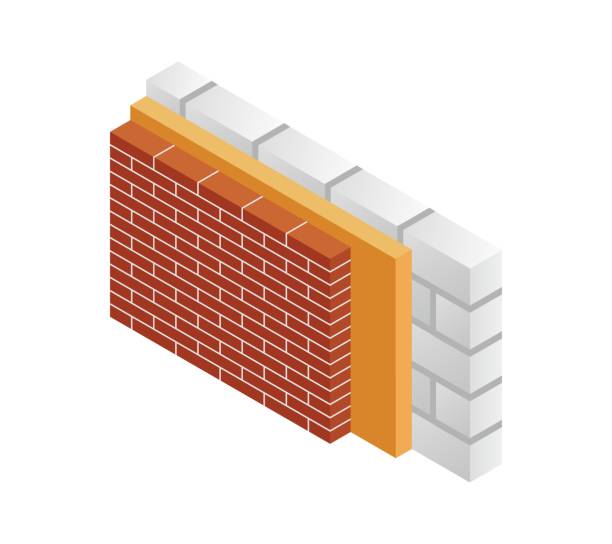
Thermal insulation with two walls and an insulating layer (wall width between 30 cm and 45 cm)
Thermal insulation can be achieved with two walls and an insulator between them, by placing a layer of insulating material between the two walls. Several types of insulating material can be used, such as polystyrene, polyurethane, glass wool, mineral wool and others.
The effectiveness of the insulation depends on the thickness of the insulator and the type of material used. In general, the thicker the insulator, the more effective the thermal insulation.
Thermal insulation can also be achieved with two separate walls, by placing a layer of insulating material between them. The insulating materials mentioned above can also be used in this method.
Thermal insulation materials can also be used on the internal or external walls of a house to improve insulation and reduce the electricity used by air conditioning and heating.
It is worth noting that thermal insulation helps to save energy and keep the home comfortable, and it can improve the value of the property when it is sold or let.
Volcanic block for wall insulation
Volcanic block can be used for thermal and sound insulation because of its excellent properties in controlling heat and noise. It can be used as a thermal insulator in roofs, walls, floors and ceilings, and as a sound insulator in walls, floors, ceilings and doors.
Volcanic block has high insulating properties. It can reduce the rate of heat exchange between inside and outside, which makes it a common choice for improving energy efficiency in buildings. This is due to the accumulation of volcanic ash granules in the block, which prevent the flow of heat and cold through the surface and so keep the temperature inside.
Volcanic block also has good sound insulation properties, as it absorbs noise and reduces the transfer of sound through surfaces and walls. This is due to its cellular structure, which absorbs and scatters sound, making it an ideal choice for improving sound quality in different buildings, such as theatres, schools, offices and homes.
In addition, volcanic block has high fire resistance, and can be used as a barrier for protection from flames and fire. It can be used in sensitive places such as hospitals, schools, hotels and government buildings.
Volcanic block factories in Saudi Arabia
There are many volcanic block factories in Saudi Arabia. Here are some known addresses:
Saudi Volcanic Block Factory
- Jeddah: Military Industries Corporation, Al-Siryan Road, Jeddah 22333, Saudi Arabia.
- Riyadh: Al-Kharj Road, after Exit 16, Riyadh 14721, Saudi Arabia.
- Dammam: Second Industrial City, Dammam 31484, Saudi Arabia.
- Qassim: Qassim, Buraydah, Second Industrial City, Saudi Arabia.
- Jazan: King Abdulaziz Road, Jazan 82612, Saudi Arabia.
The addresses of other volcanic block factories in Saudi Arabia can be found through online search engines or by contacting the relevant authorities in the Kingdom.
Superex insulating block for wall insulation
Superex insulating block is a type of thermal insulating material usually used for insulating buildings. It is made by mixing materials such as cement, sand and special insulating materials together, then casting them in special moulds to form insulating blocks.
Superex insulating block has many useful properties. It has a high capacity for thermal insulation and for keeping the temperature of the building, as well as high compressive strength and good resistance to fire, damp and mould.
Superex insulating block can be used to insulate walls, roofs and floors, and to build the external walls of buildings to improve thermal insulation and reduce the costs of heating and cooling. Superex blocks can be used together with insulation boards to achieve higher insulating efficiency.
Superex insulating block is an advanced type of thermal insulator, with many properties that make it ideal for insulation work, including:
- Thermal insulation: Superex insulating block has a high capacity for thermal insulation, as it reduces the heat transfer coefficient inside the building, which helps to reduce the costs of heating and cooling and improves thermal comfort inside the building.
- Heat resistance: Superex insulating block has high resistance to heat, so it can withstand high temperatures without its thermal performance being affected.
- High resistance to damp and mould: Superex insulating block has high resistance to damp and mould, which makes it ideal for use in damp and highly humid areas.
- Ease of installation: Superex insulating block is easy to install and shape, as it can be cut and shaped easily to fit the size and shape of different surfaces.
- Health safety: Superex insulating block contains no toxic or harmful materials, which makes it safe for use in buildings.
Superex insulating block can be used in many applications, such as the thermal insulation of roofs and of internal and external walls, and in building partitions, floors and side walls of buildings and industrial facilities. It can also be used in the manufacture of ovens.
Many companies and suppliers in Saudi Arabia provide Superex insulating block, including:
- Awazel Saudi Company: the company provides Superex insulating block in all sizes and dimensions.
- Al-Iman Al-Arabi Insulation Materials Company: the company supplies insulating materials in Saudi Arabia, and provides Superex insulating block in all sizes and dimensions.
- Al-Ruya Al-Dhakiya Insulation Materials Company: the company specialises in supplying and installing all types of thermal and sound insulators, and provides Superex insulating block at competitive prices.
- Al-Khaleej Insulators Company: the company provides Superex insulating block in different sizes at competitive prices.
- Azl Al-Khaleej Company: the company works in thermal insulation, and provides Superex insulating block in all sizes and dimensions.
More companies and suppliers of Superex insulating block in Saudi Arabia can be found by searching online or by asking specialists in thermal insulation.
Rock wool for wall insulation
Rock wool is an effective thermal insulating material, widely used in the thermal insulation of facilities and buildings. It has high thermal insulation properties, effectively reducing the transfer of heat from inside the building to the outside and the other way. This helps to improve energy efficiency and save costs in winter and summer.
Rock wool is also resistant to fire, as it does not burn or break down when exposed to high heat, which makes it a safe and highly effective choice in the event of fire.
Rock wool is widely used to insulate walls, ceilings, roofs, pipes, tanks, industrial furnaces and other industrial and construction applications. Its efficiency can be improved by installing it correctly according to industry specifications and standards, by choosing the right thickness of insulation and fixing it well.
Rock wool has several other advantages, including:
- Resistance to damp: rock wool is not affected by damp and does not expand or shrink because of it, which makes it suitable for use in damp places.
- Ease of installation: rock wool can be installed easily, whether by specialists or by amateurs.
- Light weight: rock wool is light compared with other insulating materials, which makes it suitable for use where light insulators are needed.
- Environmentally friendly: rock wool has good environmental qualities, as it contains no harmful materials and can be recycled easily.
- Low cost: rock wool is an economical thermal insulating material, with a low production cost compared with other insulating materials.
- Durability and hardness: rock wool is highly durable and hard, so it can withstand harsh weather and high pressures.
In addition, rock wool is in line with international industrial and environmental specifications, and is widely used in many countries around the world.
Glass wool and its uses in insulating walls and roofs against heat
Glass wool is a thermal and sound insulating material made of molten glass. It looks like rock wool but differs in the material it is made from. It is produced by melting glass at a high temperature and then drawing it into fine threads. It is used in many applications, such as thermal and sound insulation in construction and in the chemical, oil, food and medical industries, as well as in shipbuilding and in the car and aircraft industries. It is also used in the manufacture of electrical insulators. Among its advantages, it resists fire, mould, rats and insects, and it is not affected by damp or by relative humidity in the air.
Glass wool is widely used for insulating buildings because it provides effective, low-cost thermal insulation. It is placed between walls, ceilings and floors to reduce the transfer of heat from outside to inside in summer, and from inside to outside in winter.
Glass wool also has effective sound insulating properties. It is used to insulate ceilings and walls to reduce noise from movement and activity near the building, and to insulate rooms for music and sound recording.
Glass wool is resistant to fire and does not ignite easily, which makes it a preferred material for the thermal insulation of buildings.
Furthermore, glass wool is not affected by damp and does not cause damp to build up inside walls and ceilings, and so it prevents mould and damp forming in the building.
Glass wool can be used as rolls or boards, cut and fitted to suit the internal structure of the building. It can be installed by hand or with special equipment to fix it in place.
Glass wool is commonly used for insulating buildings around the world because of its effectiveness and its many insulating features. As well as insulating walls, ceilings and floors, it can be used to insulate pipes and ducts to reduce the transfer of heat from the fluids flowing through them.
Glass wool also has good chemical resistance. It is not affected by acids, alkalis or solvents, which makes it suitable for use in the chemical and oil industries.
Glass wool can be used in new and existing buildings alike, and in the renovation of old buildings to improve their thermal and sound insulation.
On the environmental side, glass wool can be recycled easily and reused to make more insulating products, which makes it an environmentally friendly material.
Note that working with glass wool requires the necessary safety measures. Wear suitable personal protective equipment to avoid burns to the skin or eyes, or breathing in loose glass fibres.
Dadco thermal insulation boards
Introduction
Dadco thermal insulation boards are a brand in building insulation in Saudi Arabia. They are distinguished by their high quality and their efficiency in preventing the transfer of heat, which helps to lower energy consumption and improve the efficiency of buildings.
Types of Dadco thermal insulation boards
Dadco offers a wide range of thermal insulation boards, including:
- Expanded polystyrene (EPS) boards: the most common type of thermal insulation board, light and easy to install.
- Glass wool boards: these have a high resistance to fire and provide excellent sound insulation.
- Mineral wool boards: an ideal choice for buildings that need high fire resistance, and they provide excellent thermal insulation.
- Polyurethane (PUR) boards: these have the highest capacity for insulating against heat, and they provide excellent sound insulation.
Advantages of Dadco thermal insulation boards
Dadco thermal insulation boards have many advantages, including:
- High efficiency in preventing the transfer of heat: these boards help to lower energy consumption and improve the efficiency of buildings.
- High fire resistance: some types of board, such as glass wool and mineral wool boards, provide high fire resistance, which helps to protect buildings from fire.
- Excellent sound insulation: some types of board, such as glass wool and polyurethane boards, provide excellent sound insulation, which helps to reduce noise inside buildings.
- Light weight and ease of installation: most types of board are light and easy to install, which makes them an ideal option for different types of building.
- Environmentally friendly: some types of board are made of environmentally friendly materials, such as recycled mineral wool.
Applications of Dadco thermal insulation boards
Dadco thermal insulation boards are used in many applications, including:
- Roof insulation: these boards are used to prevent the transfer of heat through roofs, which helps to lower the temperature inside buildings in summer.
- Wall insulation: these boards are used to prevent the transfer of heat through walls, which helps to lower energy consumption and improve the efficiency of buildings.
- Floor insulation: these boards are used to prevent the transfer of heat through floors, which helps to provide thermal comfort inside buildings.
- Insulating refrigerators and coolers: these boards are used to prevent the transfer of heat through the walls of refrigerators and coolers, which helps to improve their efficiency and save energy.
Buying Dadco thermal insulation boards
Dadco thermal insulation boards are available throughout Saudi Arabia. You can buy them from authorised agents or from building materials shops.
Methods for measuring the thermal insulation of buildings
- Thermal transmittance test (U-value): the thermal transmittance of the building's walls and roofs is tested with heat testing equipment. A temperature difference is applied across the two sides of the walls or roofs to measure the thermal energy transferred. These data are read and converted into a U-value, which indicates the insulating efficiency of the walls and roofs. The lower the value, the better the building's thermal insulation.
- Heat ejection test: a heat ejection measuring device is used to measure the temperature difference between inside and outside. The device is connected to the wall being tested, and the thermal values are recorded in real time to determine the insulating efficiency of the building.
- Thermal cameras: thermal cameras are used to identify hot and cold spots in walls, roofs and floors. Temperature is measured throughout the building and converted into thermal images to identify the areas that need better thermal insulation.
- Smoke test: a smoke test is used to determine how much air leaks through walls, roofs and floors. Smoke is released in the room and its spread is observed. If the smoke spreads in the area around the wall or roof, this indicates gaps in the thermal insulation and that air is leaking.
Several devices are used to measure the thermal insulation of buildings, including:
- Thermal Conductivity Meter: a device used to measure the heat conduction of materials and thermal insulators, by heating a sample of the material and determining its thermal conductivity coefficient.
- Heat Flux Meter: a device used to measure the amount of heat passing through thermal insulators, by placing the device between two walls or in the roof to measure the amount of heat passing through them.
- Infrared Camera: a device used to monitor surface temperature with high accuracy. It is used to identify any area of the building that is losing a lot of heat, and so to identify the weak points in the thermal insulation.
- Pressure Gauge: a device used to measure the air pressure inside the building and to check for leaks in walls, roofs and floors that let heat escape.
- Ultrasonic Testing Equipment: a device used to measure the thickness of walls, roofs and floors and to identify the type of thermal insulator used in them.
- Bright Light Testing Equipment: a device used to determine the amount of heat entering the building through windows and doors, and to identify the weak points in the thermal insulation.
These are some of the common devices used to measure building insulation. Other devices include:
- External air testing device (Blower Door Test): a device used to measure the rate of air leakage in the building. The device is fitted into a door or window of the building and the fan is run to create a vacuum inside the building and determine the rate of air leakage.
- Temperature and Humidity Meter: a device used to measure the temperature and humidity in the building and the amount of change in temperature between inside and outside, and so to determine the efficiency of the thermal insulation.
- Dimensional Change Gauge: a device used to measure the change in the size of thermal insulators after exposure to high temperatures or high humidity.
- Heat Transfer Testing Equipment: a device used to measure the heat transmittance of thermal insulators and to determine the efficiency of the thermal insulation.
- Fire Resistance Testing Equipment: a device used to measure the fire resistance of insulating materials and to check their ability to keep the building safe in the event of fire.
- Thermal Imaging Camera: a device used to record the temperatures in the building as thermal images, which allows technicians to identify any areas of the building that need better thermal insulation.
These are some of the devices used to measure the thermal insulation of buildings. Any of them can be used, depending on the method suited to measuring the thermal insulation of the building in question.